If you have ever watched your child flip through a favorite storybook, point to letters, or pretend to read the words, you may have wondered, “When do kids learn to read?”
It is one of those parenting questions that sounds simple but does not have one exact answer.
Some children begin recognizing and reading simple words around age four or five. Others become comfortable readers closer to six or seven. Both can be completely normal.
Reading is not a skill that suddenly appears one morning. It develops slowly through talking, listening, rhyming, recognizing letters, understanding sounds, and spending plenty of relaxed time with books.
For parents wondering when do kids learn to read, it helps to remember that reading develops gradually rather than at one exact age.
Most importantly, your child does not need to be the earliest reader in the class to become a confident reader later.
Quick Answer
Most children begin developing independent reading skills between ages 5 and 7, although some children read earlier and others need more time. Reading development starts much earlier through talking, listening, rhymes, recognizing letters, and sharing books together.
When Do Kids Learn to Read?
So, when do children start reading independently? The answer depends on the child, but many children begin developing noticeable reading skills between ages 5 and 7.
For many children, noticeable reading skills begin developing between ages 5 and 7, especially during kindergarten and first grade. Reading Rockets notes that most children learn to read by around age seven, although individual development can vary.
Some preschoolers may recognize familiar words or even read simple books before kindergarten. Other children may still be working on letter sounds and decoding during first grade.
That difference does not automatically mean anything is wrong.
The American Academy of Pediatrics explains that although some four-year-olds show a strong interest in reading and may recognize familiar words, parents do not need to push preschool children to read early.
A better way to think about reading is as a journey rather than a deadline.
Reading Begins Long Before Your Child Reads Words
You may be surprised to learn that the answer to when do kids learn to read actually begins much earlier than kindergarten.
The foundation for reading starts during infancy. These early interactions build important early literacy skills that support later reading development.
When you talk to your baby, sing nursery rhymes, point to pictures, name objects, and read bedtime stories, your child is learning how language works.
The American Academy of Pediatrics recommends sharing books with children from infancy. Babies may initially grab, chew, pat, or turn the pages, but these simple interactions are part of early literacy development.
By the toddler years, children may recognize their favorite books, pretend to read familiar stories, point at pictures, and complete repeated phrases from books they know well. These behaviors are early reading skills even though the child is not actually decoding printed words yet.
Every silly rhyme and repeated bedtime story is helping build the foundation your child will eventually use to read independently.
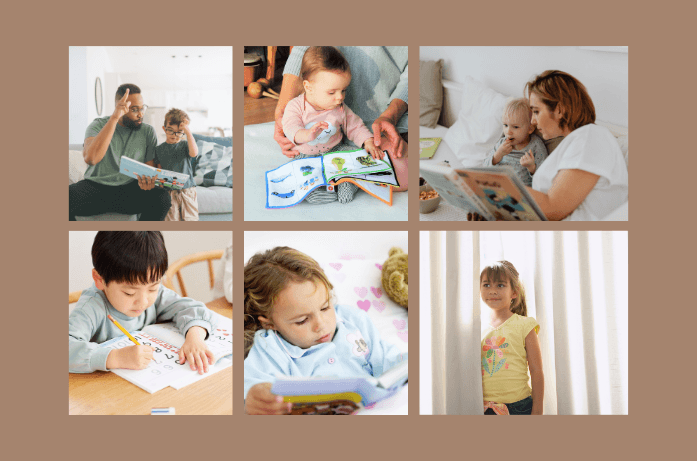
Reading Milestones by Age
Parents naturally want to know what reading development might look like at different ages. While every child follows a slightly different timeline, these general reading milestones can help you understand how literacy usually develops.
Understanding these milestones can make the question when do kids learn to read feel much less confusing for parents.
Reading is just one part of a child’s overall growth. Looking at early childhood development milestones can also help you understand how language, social, cognitive, and physical skills develop alongside early literacy.
Ages 1–2: Discovering Books and Language
At this stage, reading is mostly about interaction.
Toddlers may enjoy holding books, turning pages, pointing to familiar objects, listening to short stories, and asking you to read the same book again and again.
They may also begin naming pictures such as “dog,” “ball,” or “car.”
You are not trying to teach formal reading yet. You are helping your child understand that books are enjoyable and that pictures and words communicate meaning.
Even five or ten peaceful minutes with a book can be valuable.
Ages 2–3: Pretending to Read
Two- and three-year-olds often start behaving like little readers.
Your child might memorize a favorite story and “read” it to you using the pictures. They may finish sentences in repetitive books or notice letters they see frequently.
Many toddlers also begin recognizing the first letter of their own name.
Pretend reading is not meaningless. It shows that your child understands something important: books contain stories, words follow patterns, and reading has a purpose.
Ages 3–4: Learning Letters and Sounds
Preschool is often when children become more curious about letters.
When parents ask when do kids learn to read, this preschool stage is important because children are building the letter and sound skills they will later use for decoding.
Your child may recognize several letters, especially those in their name, and begin understanding that letters represent sounds.
They may also enjoy rhyming games and notice that words such as cat and hat sound similar.
These sound-based skills are important because learning to read involves understanding how spoken sounds connect with written letters.
The National Institute of Child Health and Human Development explains that phonemic awareness, the ability to recognize and work with individual sounds in spoken words, is an important foundation for reading.
You can encourage this naturally with songs, rhymes, word games, and playful conversations.
Ages 4–5: Early Reading Skills Appear
Around ages four and five, some children become very interested in written words.
This is often the age when families become especially curious about when do kids learn to read, because early reading skills may start becoming more visible.
They might recognize their name, identify many letters, know some letter sounds, notice familiar signs and labels, or read a handful of common words.
Some children may even begin sounding out simple words such as cat, sun, or dog.
But if your four-year-old is not reading yet, there is usually no reason to panic.
The American Academy of Pediatrics specifically notes that preschool children do not need to be pushed into reading before they are ready.
At this age, loving books and becoming curious about language may be more valuable than racing through reading levels.
Ages 5–6: Beginning to Decode Words
Kindergarten is often where formal reading instruction becomes more noticeable.
For many children, the answer to when do kids learn to read becomes clearer during kindergarten as they begin blending sounds and decoding simple words.
Children typically work on recognizing letters, matching letters with sounds, hearing sounds within words, blending sounds together, and reading simple words.
By the end of kindergarten, many children recognize most uppercase and lowercase letters and can provide sounds for many individual letters. Some are also beginning to decode simple consonant-vowel-consonant words.
Your five- or six-year-old might slowly sound out a word such as:
“c…a…t… cat!”
It may take patience, but this slow sounding-out process is an important step toward fluent reading.
Ages 6–7: Growing Into a More Independent Reader
For many families asking when do kids learn to read, first grade is when the change becomes much more obvious.
At around age six, many children begin reading familiar stories, recognizing more words automatically, using letter sounds to work out unfamiliar words, and retelling what they have read.
Their reading may still sound slow or choppy at first.
With practice, words that once required careful sounding out begin to become automatic.
By the end of first grade, many children can read simple texts independently when they have received appropriate reading instruction.
This is why ages five through seven are often considered an important window for learning to read.
What Skills Does a Child Need Before Reading?
Reading involves much more than memorizing words.
Children gradually build several connected abilities, including phonemic awareness, phonics, vocabulary, reading fluency, and comprehension.
For example, a child needs to hear that dog contains different sounds before confidently connecting those sounds with the letters D-O-G.
They also need vocabulary so they understand what the word means once they read it.
Eventually, reading becomes more than simply saying printed words aloud. Children begin understanding characters, remembering information, making predictions, and connecting stories with their own experiences.
That comprehension is the real purpose of reading.
Signs Your Child May Be Ready to Start Reading
Instead of focusing only on age, notice your child’s interest and emerging skills.
A child who is becoming ready for reading may start noticing letters everywhere, asking what words say, recognizing their own name, enjoying rhyming words, remembering favorite stories, connecting some letters with sounds, or trying to sound out simple words.
You do not need to wait until every one of these skills appears.
Reading development often happens unevenly. A child might know almost every letter but struggle with rhyming. Another might have excellent vocabulary but still mix up several letters.
Progress matters more than perfection.
How Can Parents Help Kids Learn to Read?
You do not need complicated worksheets or an expensive reading program to support early literacy.
Everyday interaction can make a meaningful difference.
A few simple habits include:
- Read together every day, even if it is only for 10–15 minutes.
- Let your child choose books that genuinely interest them.
- Point out letters and words naturally during everyday activities.
- Play rhyming and sound games.
- Talk about pictures and ask what your child thinks will happen next.
- Let your child see you enjoying books, magazines, recipes, or other reading.
- Avoid turning reading practice into a test or competition.
Reading aloud remains valuable even after children begin reading independently.
Your child may only be able to read simple sentences, while their listening comprehension allows them to enjoy much richer stories. Continuing to read together helps keep books enjoyable while exposing children to new vocabulary and ideas.
Should a 4-Year-Old Be Able to Read?
Not necessarily.
Some four-year-olds can read simple words or short books. Others are mainly learning letters, sounds, rhymes, and how books work.
Both children may be developing normally.
The AAP advises that there is no need to push a four-year-old to read simply to give them an academic head start.
If your preschooler loves learning words, follow their interest.
If they would rather build blocks, draw pictures, sing songs, and listen to you read stories, those activities also support skills that will help them later.
Reading should feel inviting, not stressful.
Should a 5-Year-Old Be Reading?
Many five-year-olds are beginning readers rather than fluent readers.
They may know most letters, understand some letter sounds, recognize several familiar words, and begin sounding out simple words.
Many parents wonder what age kids learn to read, but there is no single age when every child becomes a reader.
Others may still be developing these abilities.
Kindergarten reading instruction often focuses on these foundational skills, so a child does not necessarily need to enter kindergarten already knowing how to read.
Look for steady growth rather than expecting perfect reading.
What If My Child Is Not Reading at Age 6?
A six-year-old who is still learning to read is not automatically behind.
Children develop at different rates, and schooling, language exposure, instruction, developmental differences, and individual learning needs can all affect reading progress.
However, persistent difficulty learning letter sounds, recognizing familiar words, hearing sounds within words, or making progress despite regular instruction can be worth discussing with your child’s teacher.
Reading difficulties are easier to support when they are recognized early.
If both you and your child’s teacher are concerned, you can also discuss the issue with your pediatrician or request additional reading support or evaluation through the school.
The goal is not to label a child. It is to understand what kind of support helps them learn best.
Avoid Comparing Your Child With Other Readers
It can be surprisingly difficult not to compare.
One parent may casually mention that their four-year-old is already reading chapter books while your five-year-old is still working through letter sounds.
That comparison can create unnecessary worry.
Children do not all learn to read at exactly the same age.
An early reader is not guaranteed to become a stronger adult reader, and a child who learns later is not destined to struggle.
Instead of asking, “Is my child reading as well as someone else’s child?” try asking:
“Is my child gradually developing new skills?”
That question gives you a much healthier picture of progress.
Make Reading Feel Like Connection, Not Homework
One of the best things parents can do is protect the joy of books.
Snuggle together with a silly story.
Use funny voices.
Let your child interrupt to talk about the pictures.
Read the same dinosaur book for the fiftieth time.
Stop halfway through if everyone is tired.
These moments may not look like formal reading lessons, but they help children associate books with comfort, curiosity, conversation, and connection.
That positive relationship with reading can matter enormously as books become more challenging later.
Final Thoughts:
Most children develop meaningful reading skills during the early school years, with many learning to read between approximately ages five and seven. However, the foundation begins years earlier through conversation, songs, rhymes, storytelling, and shared books.
Some children read earlier. Others need more time and support.
Instead of worrying about reaching one perfect age, watch for gradual progress.
Keep reading together. Keep talking. Keep answering those endless questions. Celebrate the first letter your child recognizes just as happily as the first sentence they read alone.
Learning to read is not a race.
It is a collection of tiny skills that slowly come together—and having a patient, encouraging adult beside them can make that journey feel much more enjoyable.
Frequently Asked Questions
What age do most kids start reading?
Many children begin learning basic reading skills around ages five and six and become increasingly independent readers between six and seven. Development varies, so this age range should be viewed as a general milestone rather than a strict deadline.
Can a 3-year-old learn to read?
Some three-year-olds may recognize letters, their own name, logos, or a few familiar words. Most children this age are still developing the language, listening, rhyming, and print-awareness skills that eventually support reading.
Is it normal for a 4-year-old not to read?
Yes. Many four-year-olds cannot independently read yet. Preschool is generally a time for building early literacy skills and developing an interest in books rather than expecting fluent reading.
Should my child know how to read before kindergarten?
Not necessarily. Kindergarten commonly includes instruction in letters, letter sounds, phonemic awareness, and early decoding. Children enter kindergarten with a wide range of reading abilities.
How can I encourage my child to read without pressure?
Read aloud regularly, choose books based on your child’s interests, play rhyming games, talk about stories, and praise effort rather than correcting every mistake. Keeping reading relaxed and enjoyable can encourage children to keep trying.
When should I worry about my child’s reading?
A single milestone does not tell the whole story. If your child is having persistent difficulty with letter-sound relationships, identifying sounds in words, decoding simple words, or making progress despite instruction, speak with their teacher. If concerns continue, your pediatrician or school team can help determine whether additional support or evaluation would be useful.
Final Thoughts
Finding the right no screen time activities for 2 year old children doesn’t have to mean planning complicated crafts or buying expensive toys. At this age, toddlers learn best through simple everyday experiences, pouring water, stacking blocks, helping with small household tasks, exploring textures, looking at books, dancing, and spending time outdoors.
The goal isn’t to keep your little one busy every minute. It’s to give them opportunities to explore, move, imagine, and learn at their own pace. Even a few minutes of meaningful screen-free play each day can support language development, creativity, problem-solving skills, independence, and your growing connection with your child.
Most importantly, follow your toddler’s interests. Some days they may happily spend 20 minutes transferring pom-poms between bowls, while on another day they may prefer running around outside. Both are valuable forms of learning.
Keep things simple, stay flexible, and remember, your attention and presence are often more exciting to your 2-year-old than any toy or screen.
Looking for More Toddler Activities and Parenting Ideas?
If you’re always searching for simple ways to make everyday parenting a little easier and childhood a little more playful, explore more helpful parenting tips, toddler activities, learning ideas, and age-appropriate guidance at Tot Advice.
Whether you need fresh screen-free play ideas, developmental activities, or practical advice for navigating the toddler years, you’ll find plenty of inspiration to support your little one as they learn, grow, and discover the world around them.