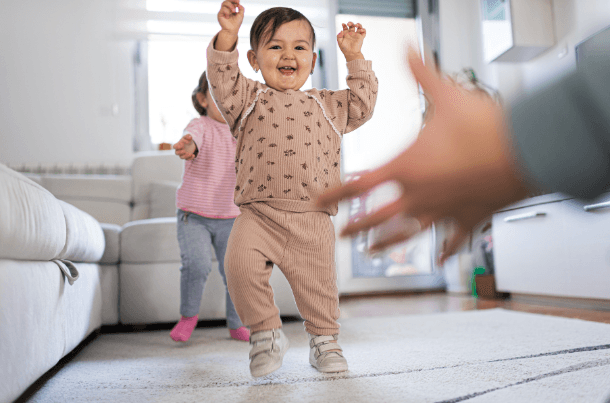
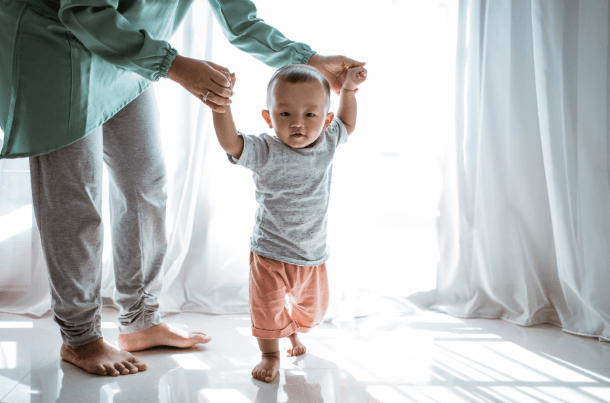
Watching your baby take their first steps is one of those parenting moments you never forget. Perhaps your little one has been cruising along the sofa for a few weeks. Then, without warning, they let go, balance for a second and take one or two wobbly steps toward you.
It is exciting, but when your baby is only nine months old, it can also leave you wondering, “Is 9 months early for first steps?”
Yes, taking independent steps at nine months is considered early, but it can still be completely normal. Many babies begin walking around their first birthday, while some walk sooner and others need several more months. Babies do not all reach physical milestones according to the same schedule.
If your baby has naturally progressed from sitting and pulling up to standing, cruising and taking steps, early walking is not usually a cause for concern. It simply means their strength, balance, coordination and confidence have developed sooner than they do for many other babies.
In this guide, we will look at the normal walking timeline, signs that a baby is ready to walk, ways to encourage movement safely and situations in which you should speak with your pediatrician.
Is It Normal for a 9-Month-Old to Take First Steps?
Yes, some healthy babies take their first independent steps at nine months.
Nine months is at the early end of the typical walking timeline, so most babies this age are not yet walking independently. Many nine-month-olds are still learning to crawl, pull themselves up or stand while holding furniture. These are all valuable stages of physical development.
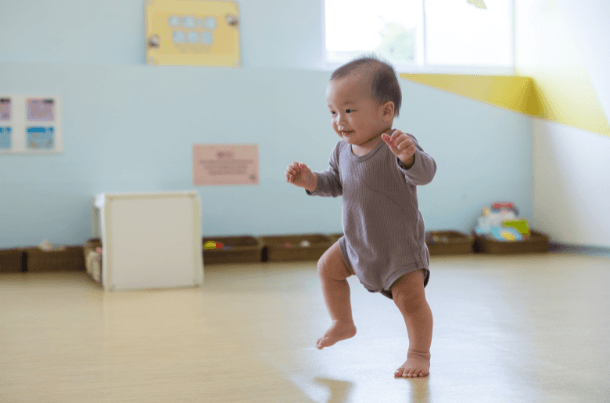
A nine-month-old who is beginning to walk may take only one or two steps before sitting down. They may walk one day and then choose to crawl for the next several days. This does not mean they have lost the skill. Crawling is often faster and feels safer while balance is still developing.
Early steps also tend to look different from mature walking. Your baby may:
- Keep their feet wide apart
- Hold their arms up or out to the sides
- Take quick, uneven steps
- Sway from side to side
- Fall onto their bottom frequently
- Walk a short distance and then return to crawling
This wide, unsteady walking style helps new walkers maintain balance. With time and practice, their steps generally become more controlled.
As long as your baby is moving comfortably, using both sides of their body and reaching the milestone without being forced, there is usually no reason to stop them from walking.
What Age Do Babies Usually Take Their First Steps?
Many babies take their first independent steps close to 12 months, but there is a broad range of normal development. Some may begin around nine months, while others may not walk independently until closer to 18 months.
A milestone is not an appointment that every baby must keep on a specific day. It is better understood as a window during which a skill may develop. Looking at your child’s early childhood development milestones as a whole can give you a clearer picture than focusing only on the exact age at which they begin walking.
The Centers for Disease Control and Prevention lists pulling up to stand and walking while holding onto furniture as physical milestones that most babies reach by one year. Taking a few steps independently is included among the milestones most children reach by 15 months, while walking without holding onto anyone or anything is listed by 18 months.
These milestone ages do not mean a baby must wait until that point to develop the skill. They help parents and healthcare providers follow a child’s overall progress and identify when extra support may be helpful.
One baby might walk at 10 months but take longer to use words. Another may be an enthusiastic communicator who begins walking at 16 months. Both children may be developing normally.
How Babies Progress Toward Walking
Walking requires much more than strong legs. Babies need core stability, balance, coordination, body awareness and confidence. These abilities develop gradually through everyday movement and play.
Your baby may move through some or all of the following stages before walking independently.
Sitting without support
Independent sitting strengthens the muscles of the back, abdomen and hips. It also teaches babies how to shift their weight and correct their position when they start to lose balance.
These same skills later help a baby remain upright while standing and walking.
Rolling, crawling or finding another way to move
Movement across the floor helps babies build strength and understand how their bodies work. Many crawl on their hands and knees, but some move by rolling, scooting on their bottoms or crawling with one leg positioned differently.
Some babies even skip traditional hands-and-knees crawling. That alone does not necessarily indicate a problem, especially when the child is otherwise moving well and using both sides of the body.
Moving into and out of different positions
Transitions are an important part of motor development. A baby learns to move from lying down to sitting, from sitting to crawling and eventually from the floor to standing.
Being able to lower themselves safely is just as important as pulling up. At first, babies may cry because they can stand but do not know how to sit down again. With practice, they learn to bend their knees and lower themselves with greater control.
Pulling up to stand
Babies usually begin by pulling themselves upright using a sofa, low table, playpen rail or a parent’s hands.
During this stage, make sure the furniture is stable and properly secured. A lightweight table or unanchored shelf can tip when a baby pulls on it.
Cruising along furniture
Cruising means walking sideways while holding onto furniture. It teaches babies to shift their weight from one leg to the other, lift a foot and place it down without losing balance.
Your baby may begin by taking a single sideways step. Eventually, they might travel around the entire sofa or move between two nearby pieces of furniture.
Standing briefly without support
Before taking independent steps, many babies begin letting go of furniture for a second or two. They may look surprised when they realise they are standing alone.
As their balance improves, they will stand for longer and may reach for a toy without immediately sitting down.
Taking the first independent steps
The first steps are often fast and wobbly because a new walker has not yet learned how to stop, turn or change direction smoothly.
Some babies take a few steps almost accidentally. Others practise standing alone for weeks before they feel confident enough to move forward.
The exact sequence can differ from one child to another. What matters most is that your baby continues gaining skills over time.
Why Do Some Babies Start Walking at 9 Months?
There is not always one clear reason why a baby walks early. Development is influenced by a combination of physical readiness, personality, environment and opportunity.
Their muscles and balance are ready
Some babies develop the core and leg strength needed for standing relatively early. They may also have good balance and coordination, making it easier for them to release their support and step forward.
They are confident explorers
Personality can affect how quickly a baby attempts a new physical skill. Some babies are adventurous and willing to fall while learning. Others are more cautious and may wait until they feel very steady before taking a step.
A cautious baby is not less capable. They may simply prefer to practise privately before showing you what they can do.
They have opportunities for free movement
Regular floor play allows babies to roll, reach, crawl, sit and pull up at their own pace. These movements naturally strengthen the body.
A baby does not need formal walking lessons or complicated equipment. A safe area with enough freedom to move is usually more helpful than devices that place the baby in a position they cannot reach independently.
They are motivated by people or objects
A favourite toy, a parent sitting nearby or an older sibling moving across the room may motivate a baby to let go of the furniture.
Although babies learn through watching and interacting with others, having an older sibling does not guarantee early walking. It is only one possible source of motivation.
Their body proportions support early balance
Babies vary in height, weight, muscle tone and body proportions. These physical differences may influence how easy or difficult it feels to balance.
This does not mean one body type is better for development. Each baby learns to control their own body in their own time.
Signs Your 9-Month-Old May Be Ready to Walk
A baby who is getting close to walking may show several signs of physical readiness. Your little one may:
- Sit independently and reach for objects without frequently tipping over
- Move easily between sitting and crawling positions
- Pull up to stand without much help
- Bear weight comfortably through both legs
- Cruise in both directions along furniture
- Transfer from one stable surface to another
- Lower themselves from standing with increasing control
- Stand alone for a few seconds
- Bend their knees to pick up a toy while holding support
- Walk forward while lightly holding your hands
- Push a stable toy while stepping
- Become increasingly interested in standing rather than sitting
Your baby does not need to demonstrate every sign before taking their first steps. Development is rarely that predictable.
It is also normal for a baby to appear physically ready but remain hesitant. Confidence is part of learning to walk, and some babies simply need more time before letting go.
Is Walking at 9 Months Too Early for a Baby’s Legs?
Parents sometimes worry that early walking will damage a baby’s legs or cause them to become bowed. A baby who pulls up and begins walking independently is generally demonstrating that their body is ready to support their weight.
You do not need to discourage a baby from standing or walking when they reach the position on their own.
It is common for babies’ legs to look slightly bowed when they first stand and walk. Their walking stance may also appear wide, with the toes pointing inward or outward. Many of these early variations improve naturally as the legs grow stronger and walking becomes more mature.
However, speak with your pediatrician if the curve appears severe, affects only one leg, becomes more noticeable over time or seems to cause pain or difficulty moving.
The important distinction is between a baby naturally choosing to stand and an adult repeatedly placing a baby into a standing position before they can support themselves. There is no need to hold a reluctant baby upright or “train” their legs to walk.
Does Early Walking Mean a Baby Is More Intelligent?
Early walking is not a reliable sign of future intelligence.
Walking is primarily a motor milestone. It depends on strength, balance, coordination, opportunity and confidence. Cognitive, language, emotional and physical skills do not always develop at the same rate.
One baby may walk at nine months but speak their first clear words later. Another may be communicating through gestures and words while still preferring to crawl.
Similarly, early walking does not guarantee that a child will become more athletic. It simply tells you that the baby developed this particular skill early.
It is natural to feel proud of your little one, but try not to use walking age as a way to measure overall ability. Babies deserve to be celebrated without being compared.
How to Support a Baby Who Is Learning to Walk
Babies do not need to be taught to walk through structured lessons. You can support the process by providing safe opportunities to move and practise.
Provide plenty of supervised floor time
A clear floor gives your baby room to roll, crawl, sit and change positions. These everyday movements strengthen the muscles needed for standing and walking.
Floor time should take place while your baby is awake and supervised. Reduce long periods in equipment that restricts natural movement when it is not needed for safety or travel.
Create safe opportunities for pulling up
Place an interesting toy on a stable, low surface that your baby can reach after pulling to stand.
Check that the furniture cannot slide or tip. Avoid tablecloths because babies may pull them and bring hot drinks, dishes or other objects down with them.
Encourage cruising naturally
You can arrange two sturdy surfaces close together so your baby can move between them. A toy placed slightly to the side may encourage them to take a sideways step.
Keep the distance small enough that your baby does not need to make a risky leap.
Let your baby practise barefoot indoors
On a safe, warm and non-slippery floor, bare feet allow babies to feel the surface beneath them. Their toes can spread and grip naturally as they work on balance.
If socks are necessary, choose a well-fitting pair with non-slip soles. Loose socks may twist or make the floor feel slippery.
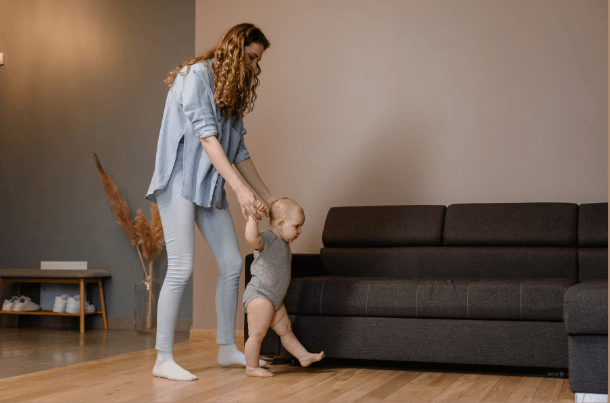
Offer your hands without pulling
If your baby wants to hold your hands, keep your support low and gentle. Avoid pulling upward on their arms or moving them faster than they can comfortably step.
Whenever possible, allow your baby to control the speed and direction.
Make practice playful
Sit a short distance away, smile and open your arms. Your baby may decide to take a step toward you, but do not pressure them if they prefer to crawl.
Walking should feel like exploration, not a performance.
Make practice playful
Minor tumbles are part of learning balance. A clear space and close supervision are more helpful than trying to catch every movement.
Reacting calmly can also reassure your baby. If adults appear frightened after every small fall, a cautious baby may become more hesitant to practise.
Are Baby Walkers Safe or Helpful?
Seated baby walkers with wheels are not recommended. They can move quickly and give babies access to hazards they would not otherwise be able to reach.
A baby in a walker may fall down stairs, pull hot objects from a table or reach medicines and cleaning products. The tray does not provide reliable protection from these dangers.
Walkers also hold babies in a position that does not require the same balance and muscle control used during independent walking. They do not help a baby learn to walk naturally and may encourage movement patterns that are not useful for developing balance.
A stationary activity centre is different because it does not move across the room, but it should still be used in moderation and according to the manufacturer’s instructions.
A push toy may be appropriate for a baby who can already pull up, stand and cruise. Choose one that is sturdy and difficult to tip. Test it yourself to make sure it does not roll away too quickly, and supervise your baby throughout its use.
Choosing Shoes for an Early Walker
Your baby does not need walking shoes inside the home simply because they have taken their first steps.
Barefoot practice on a safe surface can help a new walker receive sensory information from the floor and adjust their balance. When shoes are needed outdoors, choose a pair that:
- Fits properly without squeezing the toes
- Has a flexible sole
- Is lightweight
- Has a secure fastening
- Provides grip without being stiff or bulky
- Protects the feet from heat, cold and sharp surfaces
Check the fit regularly because babies’ feet grow quickly. Shoes should protect the feet rather than hold the ankles rigidly or force a particular walking pattern.
How to Babyproof for a 9-Month-Old Walker
An early walker can reach places you may not expect. At nine months, your baby may have the mobility to access hazards but no understanding of danger.
Review your home from your baby’s new standing height.
Anchor furniture and televisions
Secure dressers, bookshelves, television stands and other heavy furniture to the wall. Babies may pull on drawers, shelves or television units while trying to stand.
Install stair gates
Use suitable safety gates at both the top and bottom of stairs. Gates at the top must be installed securely according to safety instructions.
Never rely on supervision alone around open stairs.
Remove unstable furniture
Lightweight side tables, plant stands and floor lamps can fall if your baby grabs them. Move them out of the walking area or secure them appropriately.
Check sharp edges
Cover sharp corners or rearrange furniture to create a safer route for cruising and walking.
Keep hot items far from edges
Move hot drinks, pans and dishes well away from countertops and tables. Babies can suddenly reach higher than parents expect.
Turn pan handles inward when cooking, and keep the baby away from the stove and oven.
Secure cords and outlets
Cover accessible electrical outlets and keep appliance cords, blind cords and charging cables out of reach.
Remove choking hazards
A standing baby may find coins, batteries, small toy parts and other objects on tables or low shelves. Regularly scan the room from your baby’s level.
Button batteries and small magnets are particularly dangerous and require urgent medical attention if swallowed.
Prevent slips
Wipe up spills quickly and secure or remove rugs that slide. Keep toys away from common walking paths.
Supervise around water
Never leave a baby alone near a bathtub, bucket, toilet, pool or any other water source—not even for a moment.
What to Do When Your Baby Falls
Frequent small falls are expected when a baby begins walking. Many new walkers land on their hands, knees or padded bottoms and quickly return to playing.
Comfort your baby and check for swelling, bleeding, unusual movement or signs of pain.
Seek urgent medical advice after a serious fall or head injury, particularly if your baby:
- Loses consciousness
- Has a seizure
- Vomits repeatedly
- Becomes unusually sleepy or difficult to wake
- Is behaving very differently
- Has fluid or blood coming from the ears or nose
- Develops a large or worsening swelling
- Is not using an arm or leg normally
- Has trouble breathing
If you are uncertain about the seriousness of a fall, contact your child’s healthcare provider or local emergency service for guidance.
When Should You Talk to Your Pediatrician?
Walking at nine months is not usually a problem by itself. Still, the way your baby moves can provide important information about their development.
Contact your pediatrician if your baby:
- Consistently uses one side of the body more than the other
- Drags one leg while crawling or stepping
- Refuses to put weight on one or both legs
- Appears unusually stiff or unusually floppy
- Seems to be in pain when standing or moving
- Has a significant difference in the movement of the two legs
- Consistently stands or walks only on their toes
- Has movement that suddenly changes
- Loses a skill they previously had
A loss of previously acquired skills should always be discussed promptly with a healthcare professional.
Development should be considered as a whole. Your pediatrician will look at how your baby moves, communicates, interacts, uses their hands and responds to the world, not simply the date on which they started walking.
If your baby was born prematurely, your healthcare provider may use corrected age when reviewing early milestones. Corrected age is calculated from the baby’s original due date rather than only their birth date.
What If My 9-Month-Old Is Not Walking?
If your nine-month-old is not walking, there is usually no reason to worry. Independent walking is not expected of most babies this age.
Your baby might be:
- Sitting and reaching for toys
- Learning to move into a sitting position
- Rolling to reach interesting objects
- Crawling or preparing to crawl
- Pulling up with help
- Beginning to bear weight on their legs
- Exploring movement in another way
All of these can be meaningful parts of development.
Try to focus on gradual progress rather than comparing your baby with a sibling, cousin or another child at a playgroup. Two healthy babies of the same age may have very different strengths and timelines.
Continue attending routine well-child visits and share any concerns with your pediatrician. You do not need to wait until a milestone deadline if something about your baby’s movement worries you.
Frequently Asked Questions
Can babies really walk independently at nine months?
Is nine months too early to encourage walking?
Does a baby have to crawl before walking?
Can early walking cause bowed legs?
Should a nine-month-old wear shoes while learning to walk?
How long does it take to walk confidently after the first steps?
Is frequent falling normal for a new walker?
Is early walking a sign that my baby is advanced?
Should I worry if my baby walks early but does not talk yet?
What is considered a baby’s first step?
What can I say when my baby takes their first step?
What is the first stage before a baby starts walking?
Final Thoughts
So, is 9 months early for first steps? Yes, nine months is early, but it can still be part of healthy development.
If your baby is naturally pulling up, cruising, standing and beginning to step, give them a safe environment in which to explore. Let them practise barefoot indoors, secure furniture and supervise them closely. There is no need for special exercises, rigid walking shoes or pressure to progress faster.
And if your nine-month-old is not walking, that is completely understandable too. Most babies this age are still working on the skills that eventually lead to independent walking.
Instead of focusing on whether your baby is early or late, notice the small changes happening along the way, the first confident pull to stand, the careful sideways steps along the sofa and the delighted expression when they briefly balance alone.
Those tiny moments are all part of learning. Before long, the same little person who once needed your hands for support may be happily walking away to explore the room.
For more practical baby-development guidance, milestone tips, and everyday parenting support, explore TotAdvice for helpful resources designed to make each stage of your baby’s growth feel a little easier to navigate.
Helpful Resources
Disclaimer
This article is for general educational and informational purposes only and is not a substitute for personalised advice from your pediatrician or another qualified healthcare professional. Babies develop at different rates, and walking milestones should be considered alongside your child’s overall development. Contact your pediatrician if your baby consistently uses one side of the body more than the other, refuses to bear weight, appears unusually stiff or floppy, seems to be in pain, has a sudden change in movement, or loses a skill they previously had. Seek urgent medical attention after a serious fall or head injury if your baby loses consciousness, has a seizure, vomits repeatedly, becomes unusually sleepy or difficult to wake, has trouble breathing, or shows other concerning symptoms.
About the Author
Geeta Yogi writes warm, practical, and parent-friendly content about baby development, early milestones, newborn care, and everyday parenting. She focuses on helping parents understand their baby’s changing abilities, support development safely, and feel more confident while navigating each new stage.