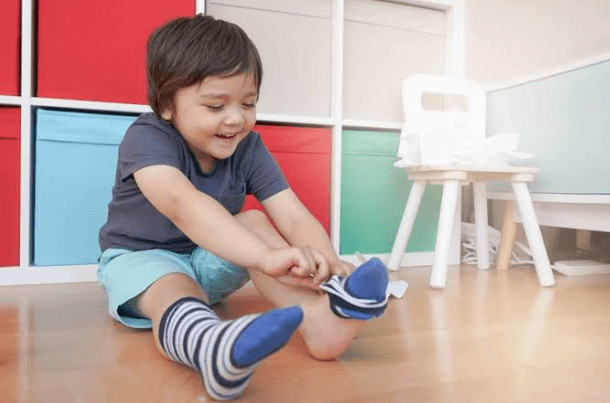
Independent dressing at home may seem like a small part of the day, but it is a surprisingly complex and valuable skill for a young child. Pulling on trousers requires balance, while managing socks, buttons, and zippers takes coordination, patience, and fine motor control.
This is why independent dressing at home is about much more than putting on clothes. It gives children a practical way to participate in family life, make simple choices and experience the satisfaction of doing something for themselves.
That does not mean a child must complete every step alone. Independence develops gradually. The goal is to offer the right amount of support while leaving room for your child to try.
Why Is Independent Dressing Important?
Learning to get dressed can help children practise several everyday skills at once, including:
- Fine motor skills needed for buttons, snaps and zippers
- Gross motor skills used when standing on one leg or pulling up trousers
- Hand-eye coordination and body awareness
- Following a sequence of steps
- Making choices and solving simple problems
- Confidence in everyday self-care
Occupational therapists can help children participate in daily activities such as dressing and can suggest strategies or adaptations based on the individual child.
When Do Children Start Dressing Themselves?
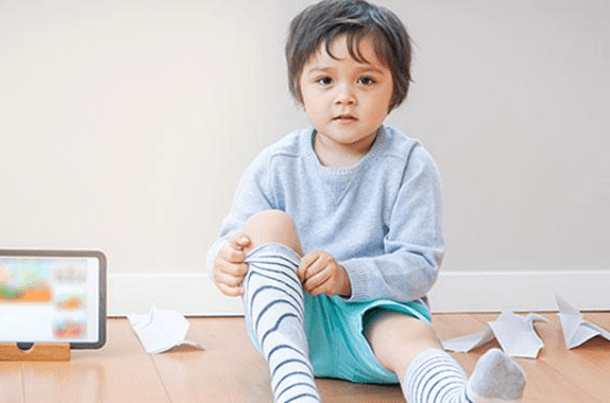
Many toddlers want to help with undressing before they can dress themselves. Removing a loose hat or pulling off socks is generally easier than putting clothes on correctly. Preschoolers may manage elastic-waist bottoms, open jackets and simple shoes but still need help with fasteners, clothing orientation or tight sleeves.
These are broad patterns, not deadlines. A child’s experience, motor development, attention, clothing design and sensory preferences can all affect the process. Celebrate the step your child is working on now, whether that is pushing an arm through a sleeve or completing an entire outfit.
5 Ideas to Encourage Independent Dressing at Home
Getting dressed takes practice. Buttons, sleeves, and even finding the front of a shirt can be tricky for young children. These simple ideas can help your child build confidence at their own pace.
1. Offer Two Simple Clothing Choices
A wardrobe full of options can feel overwhelming. Instead, choose two weather-appropriate outfits and let your child decide between them. For example, ask, “Would you like the green shirt or the yellow shirt?”
This creates meaningful choice without turning the morning into a long negotiation. If your child does not care which outfit they wear, that is fine too. You can make the decision and offer independence in another way, such as letting them choose their socks.
Keep seasonal clothes within reach and store special-occasion or out-of-season items elsewhere. Low drawers, labelled baskets or picture labels can help a child find what they need and return clean clothes to the correct place.
2. Begin With Easy-to-Wear Clothes
The right clothing can make early practice much less frustrating. Look for:
- Loose T-shirts with a wide neck opening
- Trousers, shorts or skirts with an elastic waist
- Socks with a different-coloured heel or toe
- Shoes with hook-and-loop straps or simple slip-on designs
- Jackets with a large zipper pull
- Clothing without scratchy tags or uncomfortable seams
Leave tiny buttons, stiff denim, belts and complicated fasteners for later. Once your child is comfortable with the basic sequence, introduce one new challenge at a time. A zipper, for example, is easier to learn when an adult connects the two sides and the child pulls the tab upward.
3. Break Dressing Into Small Steps
“Get dressed” may sound like one instruction to an adult, but it contains many separate actions. A child may need to choose an item, work out which way it faces, find the opening, keep their balance and pull the fabric into place.
Teach one manageable step at a time. You might pull a shirt over your child’s head and let them push their arms through, or help place trousers over their feet and ask them to pull the waistband up.
A helpful method is backward chaining: the adult completes most of the task and the child performs the final step. Once that step feels easy, the child takes responsibility for the last two steps, then three. Finishing the task lets them experience success while gradually building the whole skill.
For a shirt with a back label, you might use short, clear prompts such as:
- Find the tag.
- Put the tag at the back.
- Head goes in.
- One arm, then the other.
- Pull the shirt down.
A simple picture chart can be useful for children who find spoken instructions hard to remember.
4. Create a Child-Friendly Dressing Area
A prepared space makes independent dressing easier. It does not need to be elaborate or expensive. A small area in the bedroom can include:
- A stable child-sized chair or low bench
- A basket containing one or two outfit choices
- A low mirror
- A laundry basket nearby
- A hook at the child’s height
- Enough floor space to move safely
Sitting down to put on trousers, socks and shoes is often safer and easier than balancing while standing. Keep the space calm and uncluttered so your child can focus on the task.
The Montessori-inspired principle is simple: arrange the environment so the child can participate without needing an adult to retrieve or manage every item.
5. Allow Time, Practice and Imperfection
Children learn self-care skills through repetition. Practising for the first time five minutes before school is likely to frustrate everyone. Try the skill during a calm afternoon, before bath time or while changing into pyjamas. On busy mornings, begin earlier or choose which part your child can reasonably do alone.
Avoid immediately fixing every harmless mistake. A backward shirt or mismatched socks may be uncomfortable for an adult to look at, but they can represent real effort and problem-solving. You can neutrally ask, “Does that feel comfortable?” and give your child a chance to notice.
Step in when there is a safety issue, the clothing is unsuitable for the weather or your child directly asks for help. Support is not failure. You might say, “You worked hard on that sleeve. I’ll hold the cuff while you push your hand through.” This acknowledges effort while providing just enough assistance.
What If Your Child Can Dress but Refuses?
Being able to dress and being willing to dress are different things. A child may resist because they are tired, want more connection, dislike the transition, feel rushed or object to a particular fabric. Sometimes the argument is not really about clothes at all.
Before turning the moment into a power struggle, consider what may be making it difficult:
- Reduce decisions: Lay out one outfit the night before.
- Use a predictable routine: Breakfast, toilet, clothes, teeth and shoes can happen in the same order each day.
- Connect first: A cuddle or two minutes of calm attention may make cooperation easier.
- Use a neutral limit: “We need clothes on before we leave. Would you like to start, or would you like my help?”
- Check comfort: Ask whether a seam, label, waistband or fabric feels irritating.
- Share the job: Your child can put on the shirt while you help with trousers on a difficult morning.
Rewards and praise are not always necessary. A specific observation, such as “You found both sleeves by yourself,” helps a child notice their progress without making every routine dependent on a prize.

Common Independent Dressing Mistakes Parents Can Avoid
Helping a child learn to dress themselves takes patience. Sometimes parents unknowingly make the process harder by expecting too much too soon, stepping in too quickly, or turning dressing into a daily struggle. Avoiding a few common mistakes can make practice calmer and help children build confidence.
Expecting the Whole Skill at Once
Getting dressed involves many small steps, and children usually learn them gradually. A child who can remove clothes may not yet be able to put them on correctly.
Instead of expecting the full routine, focus on the next step your child is ready to practise. Small achievements, like pulling up trousers or putting one arm through a sleeve, help build confidence.
Correcting Every Detail
Children learn by trying, and small mistakes are part of the process. A backward shirt or mismatched socks are not always problems if your child is comfortable and dressed appropriately.
Try to focus on safety and comfort rather than correcting every small detail. Give your child a chance to notice and fix simple mistakes on their own.
Offering Too Many Choices
Choice can encourage independence, but too many options can make children feel overwhelmed. Instead of showing the entire wardrobe, offer two suitable choices.
For example, “Would you like the blue shirt or the green shirt?” gives your child control while keeping the routine simple.
Helping Too Quickly
It is natural to help when your child is struggling, especially during busy mornings. However, children need time to think, try, and solve small problems themselves.
Pause for a moment before stepping in. If help is needed, give only the support your child needs and let them complete the parts they can manage.
Practising Only When You Are in a Hurry
Learning to dress takes patience and repetition. Busy mornings are usually not the best time to teach a new skill.
Practise during calmer moments, such as after a bath or while changing into pyjamas. When children have time to try without pressure, they are more likely to develop confidence and independence.
When Might a Child Need Extra Support?
Some children need more time or adapted strategies because of differences in coordination, muscle tone, vision, attention, sensory processing or development. Consider speaking with your child’s pediatrician or another qualified healthcare professional if dressing is consistently painful, causes intense distress, or seems unusually difficult compared with your child’s other everyday skills.
Occupational therapists can help children participate in daily activities such as dressing and can suggest strategies or adaptations based on the individual child. The Children’s Therapy Network of Manitoba, for example, lists dressing among the everyday activities occupational therapists may support.
Frequently Asked Questions
How can I teach my child to put clothes on the right way?
What clothes are best for learning to dress independently?
Should I correct a backward shirt or mismatched clothes?
How can I make independent dressing faster in the morning?
At what age should a child be able to dress themselves?
Final Thoughts
Independent dressing at home is built through small, repeated opportunities, not one perfect morning. Make clothes easy to reach, offer manageable choices, divide the routine into simple steps and give your child time to practise.
Some days they may dress almost entirely alone; on others they may need more help. That flexibility does not take away their independence. By supporting effort without demanding perfection, you help your child develop practical skills and the quiet confidence that comes from thinking, “I can do this.”
For more practical parenting tips that support your child’s growing independence, explore Tot Advice
Trusted Resources
Disclaimer
This article is for general parenting information only and is not a substitute for professional medical, developmental or occupational therapy advice. Every child develops at their own pace. If you have concerns about your child’s dressing skills, development, coordination, sensory needs or daily functioning, speak with a qualified healthcare professional.
About the Author
Geeta Yogi writes practical and supportive parenting content focused on child development, independence, daily routines and family life. She shares simple strategies that help parents encourage confidence, learning and self-care skills in children.