

Healthy baby growth is about steady progress over time, not reaching one “ideal” number on the scale. Babies grow at different rates, so your healthcare professional looks at feeding, development, weight, length, and growth patterns together.
At routine visits, a healthcare professional looks at measurements such as your baby’s weight and length together and considers how their growth changes over time. Growth is assessed as a pattern rather than by focusing on one number alone. A single measurement, or a comparison with another baby, does not tell the whole story.
For parents, the most helpful approach is usually to focus on responsive feeding, safe nutrition, regular check-ups, and everyday opportunities for movement and development rather than trying to control a baby’s weight.
1. Follow Your Baby’s Hunger Cues
A hungry baby may turn towards the breast or bottle, bring their hands to their mouth, become more alert, make sucking movements, or begin to seem restless.
Crying can be a later hunger cue, so you do not need to wait until your baby becomes upset before offering a feed.
At the same time, crying does not always mean hunger. Your baby may need sleep, a nappy change, comfort, a cuddle, or a quieter environment.
As you spend more time together, you will gradually become more familiar with your baby’s individual patterns.
Responsive feeding means watching your baby’s cues and offering a feed when they appear hungry rather than making them wait simply because the clock says it is too soon.
Young babies may need frequent feeds, and feeding patterns can change during growth spurts, illness, developmental changes, or periods of increased activity.
If you are navigating those early weeks, this guide to newborn stomach capacity and feeding explains why feeds can be small and frequent and how to notice hunger and fullness cues.
2. Notice When Your Baby Has Had Enough
It can be difficult to leave milk in a bottle or food in a bowl, especially when you have spent time preparing it.
But babies do not need to finish a set amount at every feed.
Signs that your baby may be becoming full can include:
- Turning their head away
- Closing their mouth
- Relaxing their hands
- Slowing their sucking
- Losing interest in the breast, bottle, or food
- Becoming distracted or wanting to stop
Pause when you notice these cues and see whether your baby wants more.
As solids become part of their diet, allow your baby to explore food without pressure to take “one more bite.”
Responsive feeding can be used whether your baby has breast milk, infant formula, or a combination of both.
If your baby has been given a specific feeding plan because of a medical or growth concern, follow the individual advice from their healthcare professional.

3. Give Your Baby the Milk They Need Without Feeding Guilt
Breast milk and appropriately prepared infant formula can both nourish a baby.
Breastfeeding is recommended when it is possible and wanted, but families feed babies in different ways. A parent who uses formula can still practise responsive feeding by holding their baby, watching hunger and fullness cues, and pausing during bottle feeds.
For around the first six months, breast milk or infant formula is the main source of nutrition for most babies.
When complementary foods begin, milk remains an important part of the diet while your baby gradually learns to eat a wider variety of foods.
If you are unsure whether your baby is getting enough milk, talk with their healthcare professional rather than increasing, reducing, or changing feeds based only on one weight measurement, appearance, or comparison with another baby.
4. Prepare Infant Formula Safely
If you use infant formula, prepare it exactly according to the manufacturer’s instructions and the guidance given by your healthcare professional.
Do not dilute formula with extra water or make it more concentrated than directed.
Changing the powder-to-water ratio can be dangerous because babies need the correct balance of fluid and nutrients.
If you are concerned that your baby is gaining weight too quickly or too slowly, do not change formula concentration or cut back feeds without professional advice.

5. Introduce Solid Foods When Your Baby Is Ready
Around six months, many babies are ready to begin complementary foods alongside their usual milk feeds.
Readiness matters as well as age.
Signs that your baby may be ready include:
- Good head and neck control
- Ability to sit with support
- Bringing objects toward their mouth
- Showing interest in food
- Being able to manage food in the mouth rather than immediately pushing it out
There is no need to create a perfect first-food menu.
Offer age-appropriate foods from different food groups, such as:
- Vegetables
- Fruit
- Beans and lentils
- Eggs
- Meat
- Fish
- Iron-fortified cereals
- Other soft, nutrient-rich foods
Prepare foods in textures and shapes that your baby can manage safely.
Always supervise your baby while they eat.
6. Keep Choking Safety in Mind
When your baby starts solids, choking prevention becomes especially important.
Seat your baby upright for meals in a stable highchair and use the safety restraints according to the manufacturer’s instructions.
Avoid foods and shapes that pose a choking risk, and prepare foods in an age-appropriate texture.
Stay with your baby throughout the meal.
If your baby has severe eczema, a known food allergy, or another condition that may affect allergen introduction, ask their healthcare professional for individual guidance before introducing certain foods.
7. Offer Variety Without Pressure
Babies are learning how food feels, smells, tastes, and moves in their mouth.
They may touch a food without eating it, take one small taste, refuse it one day, and accept it another time.
That does not automatically mean they dislike the food permanently.
Continue offering a range of nutritious foods while respecting your baby’s appetite.
The goal is not to make your baby eat a certain amount at every meal. It is to give them repeated, safe opportunities to become familiar with different foods and textures.
8. Make Room for Family Mealtimes
When your baby is ready for a highchair, let them join you at the table when practical.
At first, they may spend more time touching, watching, squashing, and dropping food than eating it.
That is part of learning.
Sharing meals gives your baby a chance to observe other people eating and practise sitting, reaching, grasping, and self-feeding skills.
Keep the atmosphere relaxed.
Offer suitable food, sit with your baby, and allow them to decide how much they want to eat.
Mealtimes do not need to become a test of how much food disappears from the plate.
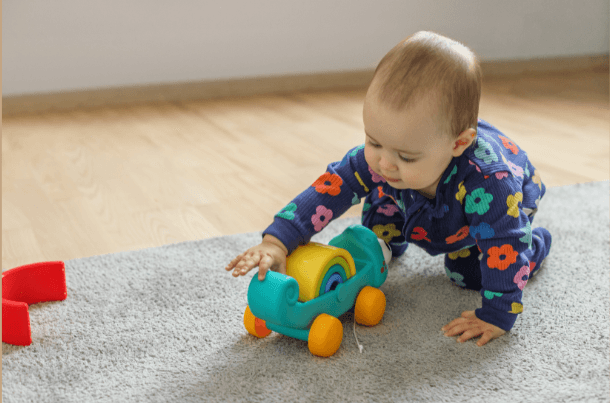
9. Encourage Safe Movement and Floor Play
Babies do not need exercise routines.
They need safe opportunities to move in ways that suit their stage of development.
Supervised floor time allows your baby to:
- Reach
- Kick
- Roll
- Push up
- Shift their weight
- Explore toys
- Practise new movement skills
These everyday movements support normal motor development.
10. Keep Tummy Time Part of the Day
Tummy time is useful while your baby is awake and supervised.
It gives babies opportunities to practise lifting the head, pushing through the arms, and strengthening the muscles used in later movement skills.
If your baby dislikes tummy time, try shorter periods rather than forcing one long session.
You can:
- Lie face-to-face with your baby
- Sing or talk to them
- Place a baby-safe mirror nearby
- Put a toy within reach
- Try tummy time on your chest while you are awake and watching closely
Remember the simple rule:
Back to sleep, tummy to play.
Tummy time is for awake, supervised babies only.
11. Look at Growth Over Time, Not One Number
Healthy baby growth is best understood by looking at measurements over time rather than judging one weight reading or comparing your baby with another child.
At routine visits, a healthcare professional considers measurements such as your baby’s weight and length together and looks at how those measurements change over time.
For children from birth to age two, healthcare professionals commonly use WHO growth standards as part of growth assessment.
A single measurement does not tell the whole story.
What matters is the overall pattern, along with feeding, development, wet nappies, activity, and general health.
Two healthy babies of the same age can look very different.
12. Do Not Put a Baby on a Diet
Babies need adequate nutrition for rapid growth and development.
Do not:
- Put your baby on a weight-loss diet
- Skip feeds to reduce weight gain
- Dilute infant formula
- Restrict breast milk or formula without professional advice
- Change feeding frequency simply because your baby looks “chubby”
Baby body shape varies widely.
If you are worried about your baby’s growth, ask their healthcare professional to assess the full pattern rather than trying to change feeds on your own.
When Should You Ask About Your Baby’s Growth?
Speak with your baby’s healthcare professional if you are concerned about:
- A sudden change in their growth pattern
- Feeding becoming consistently difficult
- Fewer wet nappies than usual
- Persistent vomiting
- Difficulty swallowing
- Unusual sleepiness or low energy
- Poor weight gain
- A sudden loss of weight
- Your baby refusing feeds repeatedly
- Any change in feeding or development that worries you
A healthcare professional can look at growth, feeding, hydration, development, and overall health together.
Do not wait for your baby to reach a certain number on the scale before asking questions if something feels unusual.
Frequently Asked Questions
Can breastfeeding hurt even if my baby’s latch looks correct?
How long should breastfeeding pain last?
Should I stop breastfeeding if it hurts?
Why do my nipples hurt after fixing the latch?
When should I ask for breastfeeding help?
Final Thoughts
Supporting healthy growth in your baby is not about chasing a perfect number on the scale.
It begins with small, responsive habits: feed your baby when they show hunger cues, respect signs that they are full, prepare milk safely, introduce a variety of foods when they are developmentally ready, and give them safe opportunities to move and play.
Try not to judge your baby’s health by their cheeks, clothing size, or comparison with another child.
Keep up with routine check-ups, ask questions when something concerns you, and focus on your baby’s overall pattern of growth and development.
Your baby does not need a perfect feeding schedule or a perfect percentile.
They need adequate nutrition, attentive care, safe feeding, and parents who respond to what they are showing them.
For more gentle, practical guidance as your baby grows, explore the baby care and feeding articles at TotAdvice.
Medical Disclaimer
This article is for general educational purposes and does not replace personalised medical advice, diagnosis, or treatment. Feeding and growth needs can vary between babies. Speak with a qualified healthcare professional if you are concerned about your baby’s feeding, growth, hydration, development, or general health.
Trusted Resources
- American Academy of Pediatrics / HealthyChildren: How Often and How Much Should Your Baby Eat?
- CDC: Using WHO Growth Standard Charts
- WHO: Infant and Young Child Feeding
- NIH Safe to Sleep: Benefits of Tummy Time
- CDC: Choking Hazards
Disclaimer
This article is intended for general educational purposes and does not replace personalised medical advice, diagnosis, or treatment from a qualified healthcare professional or lactation specialist. Seek professional support if breastfeeding pain is persistent, severe, or worsening, if your nipples are cracked or bleeding, if your baby is struggling to feed or gain weight, or if you develop breast redness, swelling, fever, flu-like symptoms, or other signs that may suggest mastitis or infection.
About the Author
Geeta Yogi writes practical, parent-friendly content about infant feeding, baby growth, starting solids, developmental milestones, and everyday baby care. She focuses on responsive, realistic guidance that helps parents understand their baby’s cues, support healthy development, and recognise when personalised advice from a healthcare professional may be helpful.